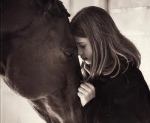
 Tina Hackel is a horse whisperer and blogs at Horsewhispering@Dr.Alzheimer : A Primary Caregiver’s reports to her support group. She cared for her husband Alex until his death from dementia, probably of the Alzheimer’s type. She started following my blog last night, and as I wandered over to read hers, I was inspired by this quote from her About page;
“All my experiences with deaf and some mute folks, with horses, and with Alex when he didn’t talk anymore, have one thing in common: I understood I had to step out of my own perception of the world, and my own thinking and feeling about it, and try to experience how they saw and understood our shared world.”
I have a feeling I could have been a horse whisperer, as I felt I had a very special connection to my horse Trixie when growing up, and to animals in general. If I had been a vet, which was my career of choice when young, my back yard would have been like Dr Doolittle’s! I think Tina has very positively translated her horse whispering skills and work with the deaf and mute communities perfectly into the most honourable way possible to care for a person with dementia.
If the carers of people with dementia are upset, appalled or react negatively in any way to our behaviour, or find our reactions are not the ones they want, they can make a choice to respond differently, PWD mostly cannot. When caring for a sick animal who cannot communicate with us, we have to sit quietly and calmly and simply ‘be’ with the animal to help it through its illness, and Tina has shown this worked well for her relationship with her husband.
This new way of helping people with dementia would take time, as the emotional toll on us all is significant, and getting used to any change is hard for almost everyone. The added challenge is that people with dementia are changing all the time, and so our carers and loved ones have to do the salsa around us, and dancing is not easy for many of us at the best of times. Tina understood she had to step out of her own perception of the world, and her own thinking and feeling about it, and try to experience how they saw and understood our shared world.
We all need time to grieve, to come to terms with the changes in behaviours, relationships, and the roles we lose or the new roles we are forced to take on. It is not an easy journey, but sharing it with others can help us understand ourselves and each other more fully, can help us to accept what is happening more easily, and definitely helps lighten the load for some of us.
Ps. Wikipedia says of – “Natural horsemanship, colloquially known as horse whispering, is a collective term for a variety of horse training techniques which have seen rapid growth in popularity since the 1980s. The techniques vary in their precise tenets but generally share principles of developing a rapport with horses, using communication techniques derived from observation of free-roaming horses, and rejecting abusive training methods.
Natural horsemanship practitioners have created an exclusionary social meme, describing the approach as being a radical departure from “traditional” techniques, which are often portrayed as being based in the use of unnecessary force. Users and practitioners tend to relate benefits in relation to the quasi-scientific narrative of the ethology of horse behaviour, and to the idea of anthropomorphic partnership.”
I think we can definitely learn a lot from them in finding ways to better care for people with dementia. Thank you Tina.


Wonderful. Reminds me of how I learned to communicate with my mother without words, which I write about in my book “Inside the Dementia Epidemic: A Daughter’s Memoir.”
LikeLike
Sounds like I’d better buy and read your book! And thanks for swinging by here, and for joining the conversation.
LikeLike
Hello, Kate, thank you so much for your kind comments on my blog introduction. To tell people how horses perceive their world and why these socially so highly sensitive animals act they way they act – that has always been part of the first lesson I taught my students. With a few of my horses, especially the one – TINO – I raised from the day of his birth, I felt I almost faiy tale like connection and communication. We seemed to listen to each others thoughts. Alex, too, was a passionate horse lover, and we both were so happy to meet Pat Parelli and participate in one of his seminars here in Berne. TINO worked like a password to Alex late in his dementia whenever he got “blocked”. Then he smiled and relaxed 😉 Wonderful holidays to you, Kate! Tina
LikeLike
I would love to meet TINO! and I love the term ‘fairy tale connection’, beautiful. Thank you for coming into my world 🙂
LikeLike